
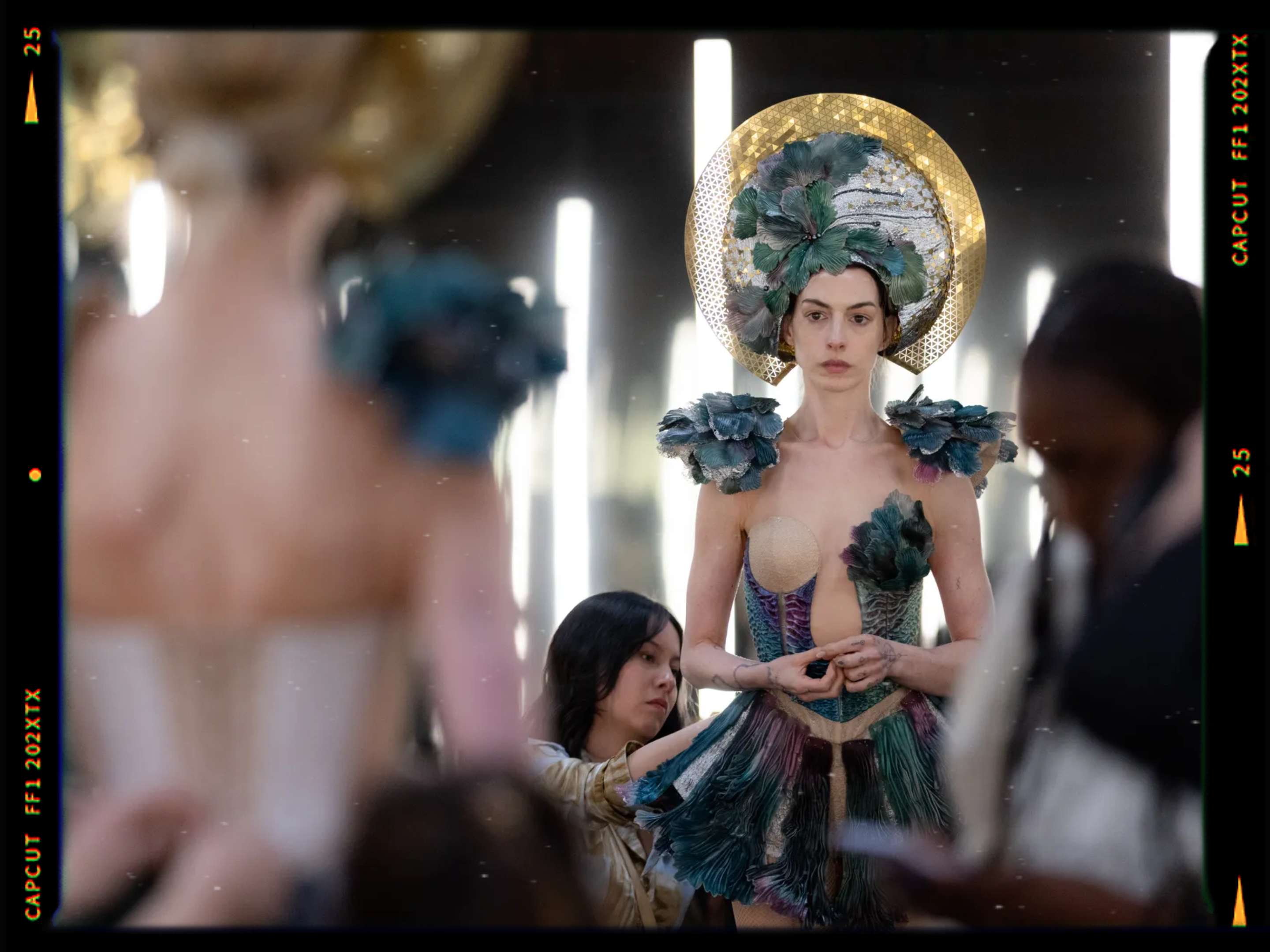
Mother Mary is an A24 film directed by David Lowery, starring Anne Hathaway as Mother Mary, a world famous pop icon preparing for a comeback performance following an onstage accident that left the public wondering whether she fell or jumped. Overwhelmed and unraveling, she shows up on the doorstep of Sam Anselm, her estranged fashion designer and former lover, played by Michaela Coel.

With three days until the show, Sam reluctantly agrees to design her a dress, and what unfolds is equal parts psychological drama, ghost story, and exploration of creative betrayal.
This film had everything it needed to be one of A24’s defining works. The cast alone should have guaranteed it. Anne Hathaway and Michaela Coel are both exceptional actresses and the film also features FKA twigs, who I love by the way and was excited to see in such a role. But somewhere in the first 40 minutes, the film loses itself in slow pacing and dialogue that drags long past the point of atmosphere into something closer to tedium.

Great acting cannot save scenes that refuse to move. If you can push through that first half though, the film rewards your patience. The moment the supernatural elements take center stage, everything sharpens and the story finally earns the tension it has been building toward.
Where Mother Mary never disappoints is in its visuals. The costume design is extraordinary. Mother Mary’s performance looks feature crystal encrusted bodysuits, sweeping capes and her signature halo headpieces, drawing from the visual language of Beyoncé’s Renaissance era, Madonna’s 1980s iconography and contemporary artists like Dua Lipa and Taylor Swift.

But the defining piece is the red draped organza gown designed by Iris van Herpen that appears in the film’s final sequence. Van Herpen described it not as a dress but as a vessel, something intended to represent transcendence and spiritual elevation. The red was deliberate, chosen because it reads as both spiritual and deeply physical.

The spiritual metaphor at the center of the film, a ghost born from one woman’s unprocessed anger that eventually possesses the other, is interesting on paper. But the film never quite commits to it with enough clarity or conviction to make it land the way it should. You spend a lot of the runtime waiting for the payoff and when it comes it feels more like a relief than a revelation.

Anyways, if you do not have the patience for slow cinema this is not the film for you. But if you can get through the first act, there is something worth seeing here. Watch it for the costumes, watch it for Michaela Coel, and watch it for that red dress.
I’ll rate this 6.2/10
Leave a Reply