
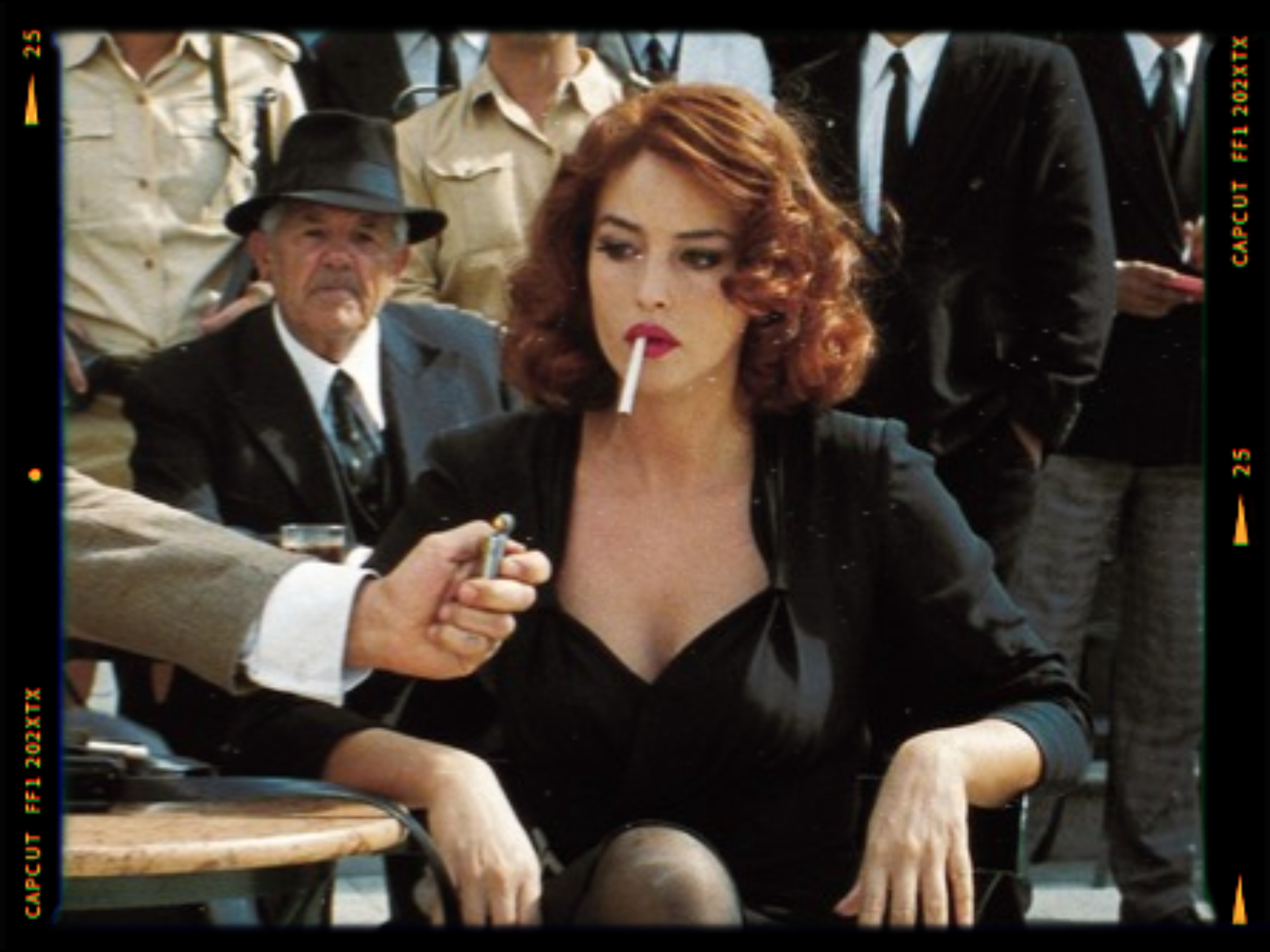
Malèna is a 2000 Italian film directed by Giuseppe Tornatore and starring Monica Bellucci. Set in World War II Sicily, the film follows Malèna, the beautiful young wife of a soldier deployed to war, through the eyes of Renato, a 13 year old boy who becomes obsessed with her. As Malèna navigates life alone in a small town that cannot decide whether to worship or destroy her, the film becomes a portrait of what it costs a woman to simply exist while beautiful in a world too small to handle it.

The Story
When we meet Malèna she has just moved to her husband’s small Sicilian town with her deaf father. She has barely unpacked before the entire town has an opinion about her. The men lose their minds every time she walks down the street and the women despise her on sight, spreading rumors and shutting her out of every social circle before she has said a single word to any of them.

What is interesting is that Malèna never acknowledges any of it. She walks with her head down, moves quietly, keeps to herself. The film frames this deliberately. Her beauty is not something she wields. It is something that happens to her, and she has spent her whole life trying not to draw more attention to it than it already does.
But here is the thing. Malèna dresses up. Her clothes are nothing outrageous but compared to the women around her she looks put together, elegant, intentional. And that is what sends them over the edge. In their minds, if her husband is not in town then what is she dressing up for? The answer is herself, but jealousy does not allow for that explanation.

When news arrives that her husband has been killed in the war, things get worse. Without a man to claim her, Malèna becomes a threat to the entire social order. She is no longer someone’s wife. She is a possibility. The men of the town see opportunity and the women see their moment to finally make her pay for existing.
She tries to find work. No one will hire her. She is taken to court on false charges of infidelity by the dentist’s wife, a man who pursued her relentlessly while she rejected him just as relentlessly. She wins the case but loses her lawyer to the same predatory behavior. One by one every man who claims to want her fails her when it actually counts.

With no family, no income, and no food, Malèna makes a decision. If the town has already written the story of who she is, she will write her own version of it. For the first time in the film she walks with her head up. She looks people in the eye. She takes ownership of the only thing that has ever been truly hers, her beauty, and she uses it to survive. It is not liberation. It is capitulation dressed in the only armor she has left.

When the war ends and the Nazis leave, the women of the town take their revenge. They drag Malèna into the street, strip her, and beat her. Not one man who claimed to desire her lifts a finger to help her. She leaves the town barely standing.

A year later she returns with her husband, who survived the war after all. She is older, dressed more simply, her hair shorter. The town’s women, who once made her life a living hell, now smile at her. She has been made safe by time and circumstance. She is no longer a threat. And they accept her for exactly that reason.

The Analysis
This film is fascinating because it is fundamentally about hypocrisy. Society worships beauty and punishes women for having it. The women in this town do not hate Malèna because she is beautiful. They hate her because her beauty exposes their husbands’ disloyalty and their own insecurities, and she gives them nothing to work with because she never fights back, never bends into the image they have painted of her.

That is actually one of the biggest lessons in this film. Nothing frustrates a jealous person more than when you refuse to become the villain in the story they have written about you. They want you to be a bitch so that when you act nice they can call you fake. They want you to be a whore so that when you are not they can call you a liar. The moment you start trying to correct the narrative, you hand them your power because the truth is their opinion is only valuable if you treat it like it is.

The other lesson is harder. Malèna made the mistake of assuming that the men who desired her would protect her when it mattered. They did not. They never do. Men who see you primarily as a sexual object will always disappoint you when you actually need them. Do not confuse desire with loyalty. They are not the same thing.
Side Eye Critic
This film was written and directed by a man and it shows. The sexual tension built between a grown woman and a 13 year old boy is genuinely disturbing and the film does not treat it as the problem it is. It treats it as charming. Renato’s obsession is framed as innocent adolescent longing rather than what it actually is. The fact that the film ends with Renato finally speaking to Malèna, as if his obsession was a love story with a conclusion, is telling.

Even more frustrating is that this is Malèna’s story and yet she never gets to tell it. Every scene of her suffering, her transformation, her survival, is filtered through the perspective of a boy who sees her as a fantasy rather than a person. That is not an accident. This film was clearly made for a male audience and Malèna exists in it to be looked at, desired, and pitied, never to be truly understood.
Conclusion
The film received a 54% on Rotten Tomatoes from critics and 84% from audiences, which tells you something about who this story resonates with. My rating sits closer to 76% and here is why. The film’s biggest flaw is that it tells Malèna’s story entirely through the eyes of a boy who is obsessed with her. We never get inside her perspective.

We never hear her inner voice. We watch her suffer and survive and transform entirely through the male gaze, and a woman this complex deserved better than that. Monica Bellucci does extraordinary work with what she is given but Malèna deserved to be the narrator of her own story.
That said, it remains one of the most honest films ever made about what the world does to a beautiful woman who refuses to apologize for it.
Leave a Reply