
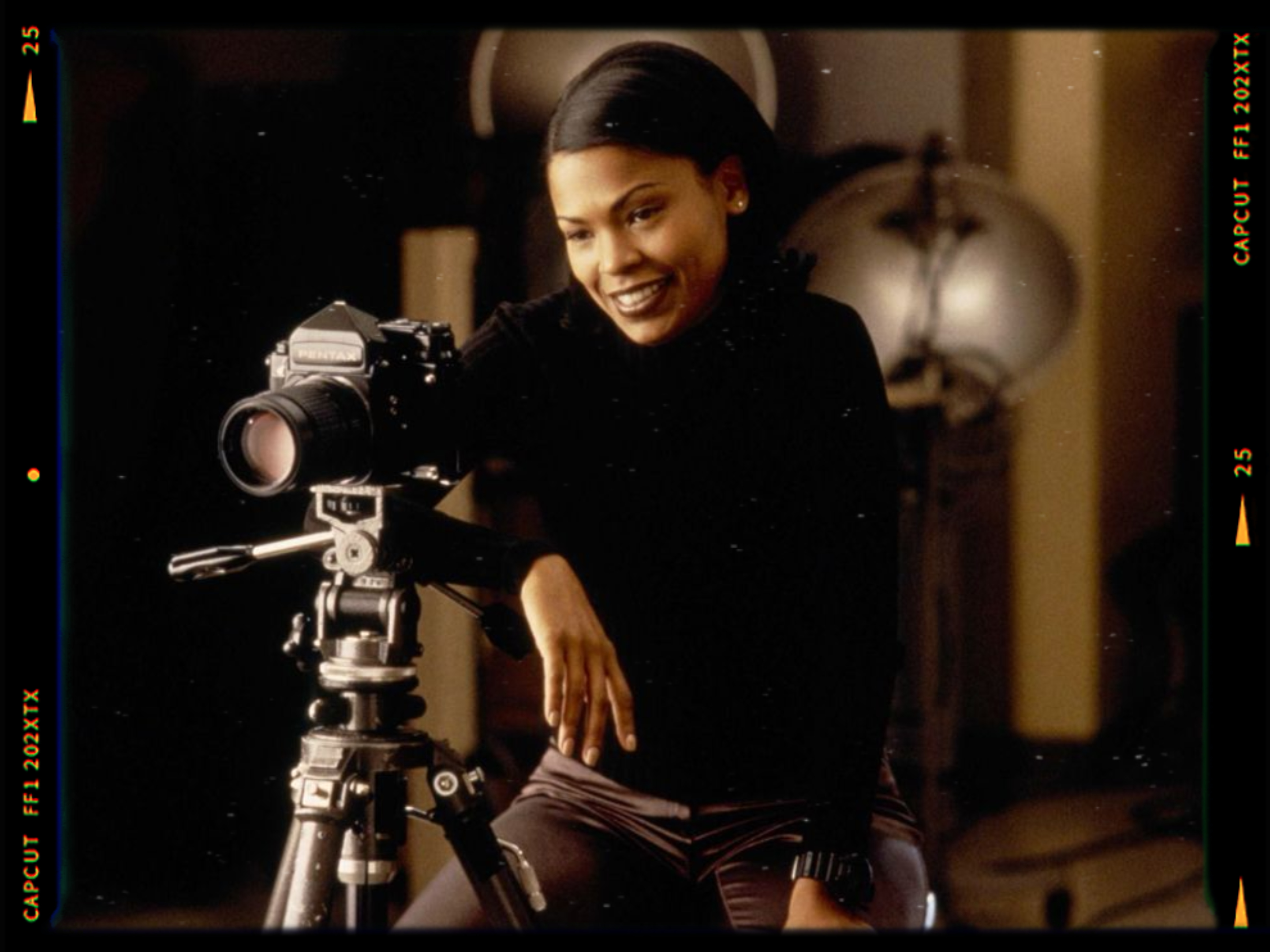
Nearly three decades after its release, Love Jones is still the movie people point to when they want an example of what a grown and sexy love story looks like on screen. Set in Chicago’s Black arts community, we are taken into a world of poets, photographers, and intellectuals. Revisiting it now, what stands out almost as much as the romance is how effortlessly stylish it was.

Love Jones is about a talented but struggling photographer in Chicago named Nina Mosley, freshly out of a relationship with her ex, Marvin, when she and her friend Josei hit up the Sanctuary, an upscale spot where the city’s poets and artists gather. That’s where she meets Darius Lovehall, a smooth-talking poet who’s immediately smitten the second he spots her at the bar. He performs a poem that wins over the room, but it doesn’t quite win over Nina, who’s looking for something deeper than a pickup line dressed up in verse.
They keep running into each other, first at a record store, then at her doorstep when Darius tracks down her address just to deliver a CD she was hunting for. It’s a lot, but it works. One date turns into a full relationship, complicated almost immediately when Marvin resurfaces begging Nina to come back to New York. She’s honest with Darius about still having feelings for her ex, and hurt, Darius decides two can play that game.

Nina goes to New York, gets rejected by the art scene there, realizes going back to Marvin was a mistake, and returns to Chicago, only to find Darius already moved on. In true messy fashion, she starts dating Darius’s own so-called friend Hollywood, which pushes Darius to finally see Hollywood for who he really is. The two reconcile, fall back into their rhythm of poetry nights and record stores, only for jealousy to break them apart again when Darius gets a call from another woman. Nina leaves for New York for good, or so it seems, until Darius nearly misses her train and later spends a year regretting that he let her go without a word.

A year later, their paths cross again in Chicago. Nina reads a poem on the Sanctuary stage, hoping Darius is somewhere in the crowd listening. He is. He follows her outside, tells her he never stopped loving her, and the film ends with the two of them figuring out how to make it work, standing in the rain.
Love Jones is a 1997 film written and directed by Theodore Witcher, starring Nia Long and Larenz Tate. Interestingly, the role of Nina was originally written for Jada Pinkett Smith, who turned it down. It’s hard to imagine now, because the chemistry between Long and Tate is a huge part of why this film has held up so well.

Now let’s talk about the style, because Love Jones is as much a fashion time capsule as it is a love story. The film hit theaters right as fashion was shifting from ’90s minimalism into the more label-obsessed look of the 2000s, and its wardrobe sits right in that sweet spot, earth tones, rich sweaters, black leather jackets, boot-cut jeans, motorcycle boots. Compared to flashier films from the same era documenting Black adult life, like Belly or Boomerang, Love Jones is quietly stylish, which is part of why the style has stood the test of time. Nia Long’s bob became one of the most copied haircuts of its decade, and it’s still referenced today.

The look extends beyond clothes too. Think trench coats, turtlenecks, oversized hoodies, cashmere, paired with natural, barely-there makeup and the kind of classic brown lip liner that’s cycled back into style more than once since. And the soundtrack does just as much work as the wardrobe, Coltrane, the Isley Brothers, Al Green, all scoring a romance that treats music like it’s part of the courtship itself. Darius even says it outright in the film: “Romance is about the possibility of things.” That line alone tells you everything about what this movie is actually selling, not perfection, just possibility.

That’s the real reason Love Jones has aged the way it has. It didn’t chase trends when it came out, and because of that, it never really went out of style. Every look from that movie, both Nina’s and Darius’s, could be worn today. It’s a love letter to Black bohemia and spoken word culture in the late 90s, and nearly 30 years later, it’s still the movie people turn to when they want a beautiful love story.
Leave a Reply