
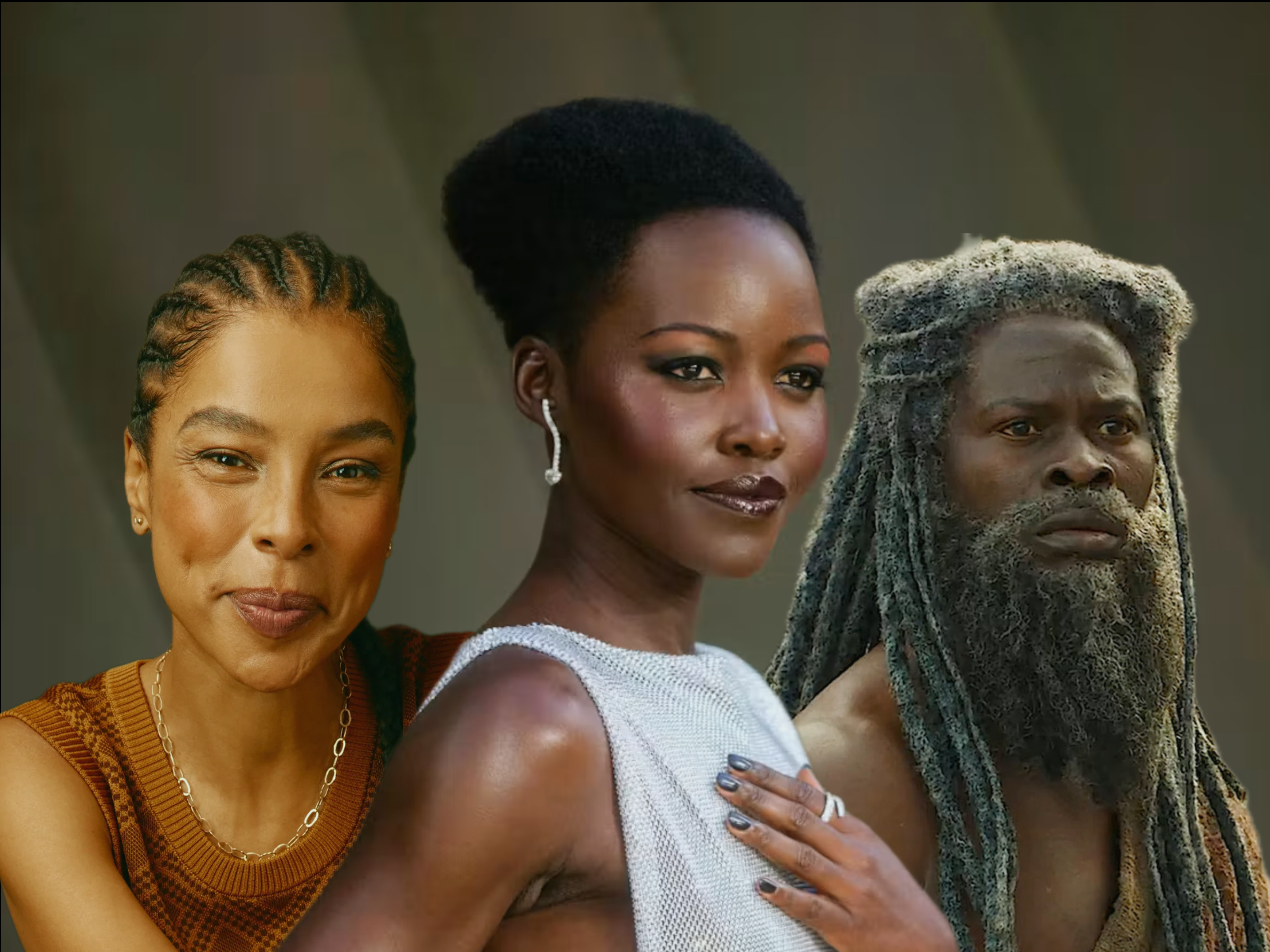
Imagine spending years perfecting your craft, finally landing a role that showcases your talent, receiving an Oscar nomination for your performance, and then still struggling to get an audition even after all those accolades.
Well, that was the reality for actress Sophie Okonedo and many more Black actors.

In a recent interview with Vulture, the British Nigerian actress opened up about her career following her 2005 Academy Award nomination for Hotel Rwanda. And while the nomination introduced her to a new level of recognition, it didn’t necessarily introduce her to a new level of opportunity.
“Even after the Oscars, I wasn’t getting auditions,” Okonedo revealed.
Now, if an Oscar nomination isn’t enough to get your foot in the door, what exactly are Black actors expected to do?
If An Oscar Isn’t Enough, Then What Is?
What I found particularly interesting about Sophie’s interview was that she wasn’t complaining about losing roles to other actresses. The problem was that the roles she wanted simply either didn’t exist or she couldn’t get access to them even after proving she’s more than capable.
Okonedo continued working in England, building an impressive career in theater, where she would eventually win a Tony Award for A Raisin in the Sun.

Now, more than two decades after her Oscar nomination, she’s finally getting the kind of leading roles she deserves, including the titular character in Clarissa, a contemporary Nigerian adaptation of Virginia Woolf’s Mrs. Dalloway.
And while I’m excited to see Sophie getting her flowers, I can’t help but wonder how many incredible performances we’ve missed out on because the industry couldn’t imagine her as the leading lady.
Unfortunately, her experience isn’t an isolated one.
Hollywood’s Obsession With Black Trauma
Last year, Oscar winner Lupita Nyong’o revealed in a conversation with Angélique Kidjo on CNN that following her Academy Award win for 12 Years a Slave, she was offered more roles portraying enslaved women.
One of those offers even involved playing another enslaved woman aboard a slave ship.
Now, let me get this straight. A woman delivers an extraordinary performance, wins the most prestigious award in film, and the industry’s first thought is to put her back in a similar role playing another enslaved woman?

What makes this frustrating is that Lupita’s career has since demonstrated just how versatile she is. From playing a warrior in Black Panther to delivering two incredible performances in Jordan Peele’s Us, she has proven that she can excel across genres.
And this is my issue with Hollywood’s relationship with Black storytelling.
There is absolutely nothing wrong with telling stories about slavery, racism or the hardships Black people have endured. These are important stories that deserve to be told. But when those stories become some of the few avenues through which Black actors can achieve mainstream recognition, then there is clearly a problem.
And this isn’t a new conversation. Black actors themselves have been pointing this out for years. Yet here we are in 2026, still having the same conversation. In fact, following the industry’s numerous commitments to diversity during the Black Lives Matter movement, I would argue that opportunities for Black women, particularly monoracial Black women, seem to have become even more limited.
As a Black woman who loves cinema, I want to see Black women fall in love, solve mysteries, embark on ridiculous adventures, play complicated villains and make terrible decisions that have absolutely nothing to do with the color of their skin.
Take a look at the current Top 10 movies and TV shows on Apple TV, for example. What immediately stands out to me isn’t just the lack of Black leading characters, but the variety of stories white characters, particularly white men, get to exist in. From small-town mysteries in Widow’s Bay to navigating alternate realities in Dark Matter, we get to see these characters exist across an entire spectrum of genres and experiences.

And then there’s the distinction between representation in marketing and representation in storytelling.
Take Netflix’s The Body, currently the number one show in the U.S. at the time of writing. Grace, a Black character, is featured prominently in the show’s promotional imagery. Yet she’s a supporting character who spends most of the season in a coma, while the story primarily follows the other girls.

Now, if you’ve read my review of The Body, you know how much I love this show. In fact, I enjoy quite a few of the shows featured on these lists. And that’s precisely my point. The problem isn’t that these stories exist. The problem is that we aren’t seeing enough Black characters at the center of equally diverse stories.
While these charts are only a snapshot of what’s currently popular, they offer a rather telling picture of the entertainment landscape.
Give me more Black women in psychological thrillers whose biggest problem is that they’re terrible human beings. We deserve the same creative freedom to explore the complexities of the human experience that other actors are afforded.
The Awards Are Nice, But What About the Paycheck?
And then there’s Djimon Hounsou.
The two-time Academy Award nominee, whose filmography includes Amistad, Gladiator, Blood Diamond and several major Hollywood franchises, revealed in a 2025 CNN interview that he was still struggling financially.
“I’m definitely underpaid,” the actor admitted.
After decades in the industry, two Oscar nominations and appearances in some of Hollywood’s biggest films, Hounsou still finds himself having to advocate for fair compensation.

Of course, financial instability is not exclusive to Black actors. Acting is an unpredictable profession, and even successful actors can experience long periods without work. But when you consider Hounsou’s experience alongside those of Okonedo and Nyong’o, it raises questions about how much value Hollywood actually places on Black talent beyond the awards ceremony.
Because what good is being recognized as one of the best actors in your industry if that recognition doesn’t translate into better opportunities, greater creative freedom or fair compensation?
Representation Isn’t the Same as Investment
According to UCLA’s 2026 Hollywood Diversity Report, Black actors accounted for just 6.5% of leading roles in the top theatrical films of 2025, compared to 76.9% for white actors.
And while there has undoubtedly been progress in Hollywood, these numbers suggest that progress isn’t necessarily permanent.
I think part of the problem is that we’ve become so accustomed to celebrating milestones that we sometimes forget to question why those milestones are still so difficult to achieve.
We celebrate the first Black actress to accomplish something. We celebrate the rare Black actor who breaks through. We celebrate the success of a Black-led film.

But what happens after the celebration?
I find it particularly frustrating that so much of the conversation surrounding Black talent revolves around proving ourselves worthy of opportunities rather than questioning why those opportunities are so limited in the first place.
Not every Black actor should have to be the next Viola Davis or Denzel Washington to have a sustainable career in Hollywood. And not every Black-led film should have to become a cultural phenomenon to justify the existence of another one.
Black actors deserve the opportunity to be extraordinary, but they also deserve the opportunity to be ordinary. To star in a mediocre romantic comedy, a silly action movie or a film that doesn’t perform particularly well at the box office, without that failure becoming an indictment of Black-led films as a whole.
Hollywood has spent decades acknowledging Black excellence. Perhaps it’s time the industry started investing in it.
Leave a Reply